
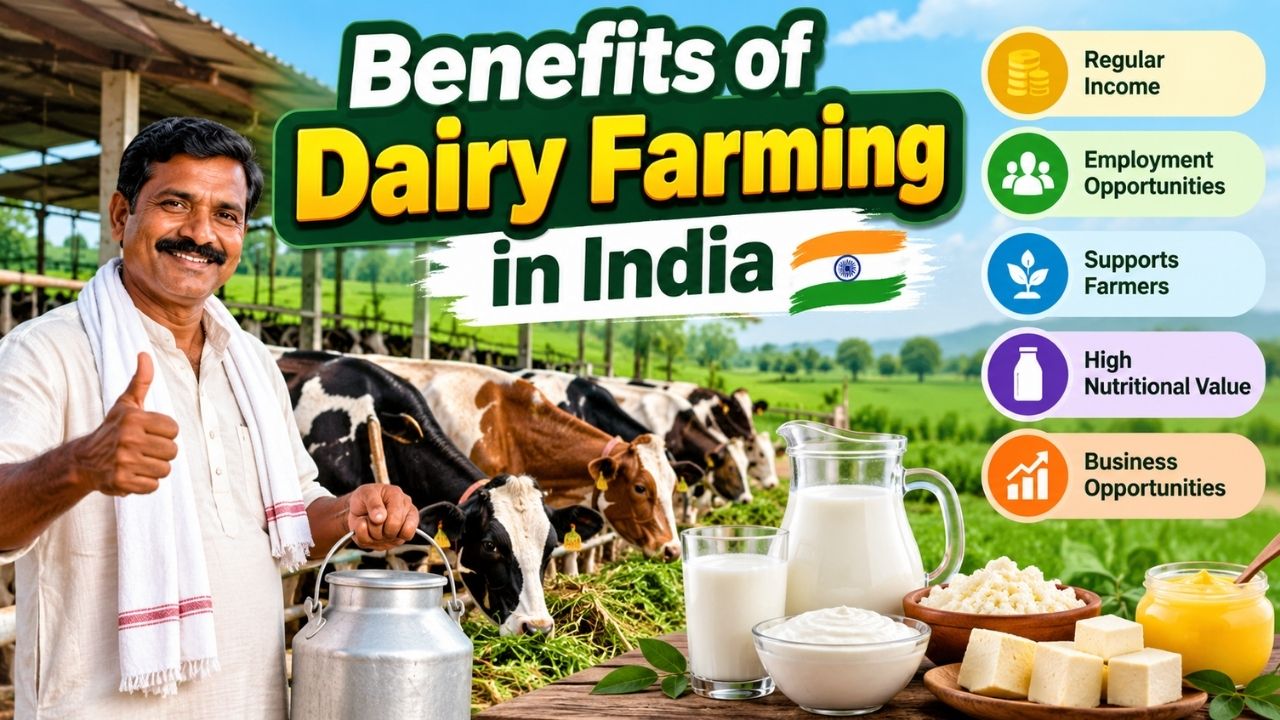
Dairy farming in India is one of the most important parts of the country’s agriculture and rural economy. Millions of farmers depend on cows, buffaloes and other dairy animals for their livelihood. Apart from providing a regular source of income, dairy farming creates employment, supports agriculture and contributes significantly to India’s milk production.
With increasing demand for milk, curd, paneer, ghee and other dairy products, dairy farming can provide farmers with an additional and potentially sustainable source of income when managed properly.
What is Dairy Farming?
Dairy farming is the practice of raising and managing animals such as cows and buffaloes for milk production. Farmers provide animals with proper feed, water, shelter, healthcare and breeding management to maintain milk production.
Dairy farming can be practiced on a small scale with a few animals or as a commercial dairy farm with a larger number of animals.
Top Benefits of Dairy Farming in India
1. Provides a Regular Source of Income
One of the biggest benefits of dairy farming is the possibility of generating regular income from milk sales. Unlike many agricultural crops that may provide income only after harvesting, milk can be sold daily or at regular intervals.
Farmers can sell milk to:
- Local dairy cooperatives
- Milk collection centres
- Private dairy companies
- Local shops
- Hotels and restaurants
- Direct customers
The actual income depends on milk yield, milk price, feed costs, animal health and farm management.
2. Creates Employment Opportunities
Dairy farming generates employment for farmers and rural workers. Activities such as feeding animals, cleaning sheds, milking, transportation and milk collection require regular labour.
It can also create indirect employment in:
- Veterinary services
- Animal feed businesses
- Dairy processing
- Milk transportation
- Equipment manufacturing
- Dairy product retail
Therefore, dairy farming contributes to rural employment and local economic development.
3. Supports Small and Marginal Farmers
Dairy farming can complement crop farming, particularly for small and marginal farmers. A farmer does not necessarily need a very large landholding to maintain a small dairy unit.
Farmers can combine:
Crop Farming + Dairy Farming = Diversified Farm Income
Crop residues can sometimes be used as animal feed, while properly managed cattle manure can be used as organic fertilizer.
4. Provides Additional Income Alongside Agriculture
Agriculture can be affected by rainfall, weather conditions, pests and changing market prices. Dairy farming provides another income source that can help farmers diversify their livelihood.
For example, a farmer may grow:
- Paddy
- Maize
- Ragi
- Vegetables
- Pulses
while also maintaining dairy animals.
This diversification can reduce dependence on a single agricultural activity.
5. Milk Has High Nutritional Value
Milk is an important source of nutrients, including protein, calcium, phosphorus and several vitamins. Dairy products such as curd, paneer and milk can form part of a balanced diet.
The dairy sector therefore contributes not only to farmers’ livelihoods but also to food and nutritional security.
6. Provides Raw Material for Dairy Products
Milk is used to produce many products, including:
- Curd
- Butter
- Ghee
- Paneer
- Cheese
- Milk powder
- Flavoured milk
- Ice cream
- Other processed dairy products
This creates opportunities for farmers, dairy processors, self-help groups and small businesses.
7. Animal Manure Can Be Used as Organic Fertilizer
Cattle manure is a valuable agricultural resource. Farmers can use properly composted manure to improve soil organic matter and support crop production.
Manure can also be used in certain systems for biogas production, providing another potential benefit for rural households.
8. Supports Women in Rural Areas
Dairy activities are often closely connected with household and rural farm work. Women may participate in activities such as feeding animals, milking, cleaning sheds and managing dairy-related tasks.
Through dairy cooperatives and self-help groups, dairy farming can also provide opportunities for women to participate in income-generating activities.
9. Supports the Rural Economy
Dairy farming creates demand for various goods and services, including:
- Animal feed
- Veterinary medicines
- Dairy equipment
- Transportation
- Veterinary services
- Milk collection
- Dairy processing
As a result, income generated through dairy farming can circulate within rural communities.
10. Opportunity for Value-Added Dairy Businesses
Farmers and entrepreneurs can increase the value of milk by processing it into different products.
Instead of selling only raw milk, businesses may explore products such as:
Milk → Curd → Paneer → Ghee → Other Dairy Products
Value-added dairy products can create additional business opportunities, although profitability depends on production costs, market demand, quality, regulations and distribution.
Importance of Dairy Farming in India
India has a large dairy sector and milk is an important agricultural commodity. Dairy farming plays an important role in supporting rural livelihoods and supplying milk to consumers across the country.
The sector also has strong connections with agriculture because livestock can provide manure, while agricultural residues and fodder crops can contribute to animal feeding systems.
Dairy Farming and Farmer Income
The income from dairy farming depends on several factors:
- Number of dairy animals
- Breed and genetic quality
- Daily milk production
- Milk selling price
- Feed and fodder expenses
- Veterinary expenses
- Labour costs
- Electricity and water costs
- Animal health
- Dairy management practices
Farmers should calculate both gross income and total expenses before expanding their dairy business.
Simple Dairy Income Example
Suppose a farmer has 5 dairy animals and each animal produces an average of 8 litres of milk per day.
Total milk production:
5 × 8 = 40 litres per day
If milk is sold at ₹40 per litre:
40 × ₹40 = ₹1,600 per day
Estimated monthly gross milk revenue:
₹1,600 × 30 = ₹48,000
This is gross revenue, not profit. Feed, healthcare, labour, electricity, transportation and other expenses must be deducted to calculate the actual profit.
Challenges of Dairy Farming in India
Although dairy farming provides many opportunities, farmers should also understand the challenges.
Major challenges include:
- High cost of cattle feed
- Animal diseases
- Veterinary service availability
- Fluctuating milk prices
- Water requirements
- Labour requirements
- Maintaining hygiene
- Heat stress during summer
- Breeding and fertility management
- Initial investment
Proper planning, animal healthcare and financial management are important for running a sustainable dairy farm.
Government Support for Dairy Farmers
The Government of India and state governments implement various programmes and schemes related to livestock development, dairy development, animal health, breed improvement and infrastructure.
Farmers should check the latest eligibility requirements, subsidy rules and application procedures through official government departments, banks, dairy cooperatives and livestock development agencies because scheme conditions can change.
How to Start a Dairy Farm in India
Farmers planning to start a dairy farm should consider the following steps:
- Prepare a dairy farming business plan.
- Decide the number of animals.
- Select suitable dairy breeds according to local conditions.
- Arrange adequate water and fodder.
- Build a clean and well-ventilated cattle shed.
- Purchase healthy animals from reliable sources.
- Establish vaccination and veterinary care schedules.
- Maintain proper feeding practices.
- Identify a reliable milk market.
- Maintain records of milk production and expenses.
Conclusion
Dairy farming in India provides several opportunities for farmers, including regular milk income, employment generation, agricultural diversification and value-added dairy businesses. It can work particularly well when combined with crop farming and proper livestock management.
However, dairy farming should be treated as a business rather than simply keeping animals. Farmers should carefully calculate feed costs, animal productivity, healthcare expenses, milk prices and market demand before making major investments.
With proper planning, good animal management, suitable infrastructure and access to reliable markets, dairy farming can become an important part of a diversified rural livelihood.
Frequently Asked Questions (FAQs)
Is dairy farming profitable in India?
Dairy farming can be profitable, but profitability varies depending on milk yield, animal health, feed costs, milk prices, labour and farm management. Farmers should calculate expected revenue and expenses before starting.
How many cows are needed to start a dairy farm?
There is no fixed number. A farmer can start with a small number of animals and gradually expand after gaining experience and understanding the local market.
What are the main benefits of dairy farming?
The major benefits include regular milk income, employment generation, additional income for farmers, agricultural diversification, manure availability and opportunities for dairy-product businesses.
Which animals are commonly used for dairy farming in India?
Cows and buffaloes are the most commonly used dairy animals in India. The appropriate breed depends on factors such as climate, feed availability, management practices and milk-market requirements.
Can dairy farming be combined with crop farming?
Yes. Crop and dairy farming can complement each other. Crop residues can potentially be used as feed, while properly managed livestock manure can be used as organic fertilizer.
What are the major expenses in dairy farming?
Major expenses can include animal purchase, feed and fodder, veterinary care, labour, housing, water, electricity, transportation and equipment.
- Dairy farming in India
- Dairy farming benefits
- Importance of dairy farming in India
- Dairy farming income
- Dairy business in India
- Dairy farming for farmers
- Advantages of dairy farming
- Milk production in India
- Dairy farm business
- Rural dairy farming
1 thought on “Benefits of Dairy Farming in India: Income, Importance & Opportunities”