
The Rashtriya Swasthya Bima Yojana (RSBY) was a government-sponsored health insurance scheme introduced to provide health insurance protection to Below Poverty Line (BPL) families and certain categories of unorganised-sector workers. It was launched on 1 October 2007 and became operational from 1 April 2008.
The scheme used a smart card-based, cashless health insurance system, allowing eligible beneficiaries to receive treatment at empanelled hospitals without paying the covered hospitalisation expenses upfront.
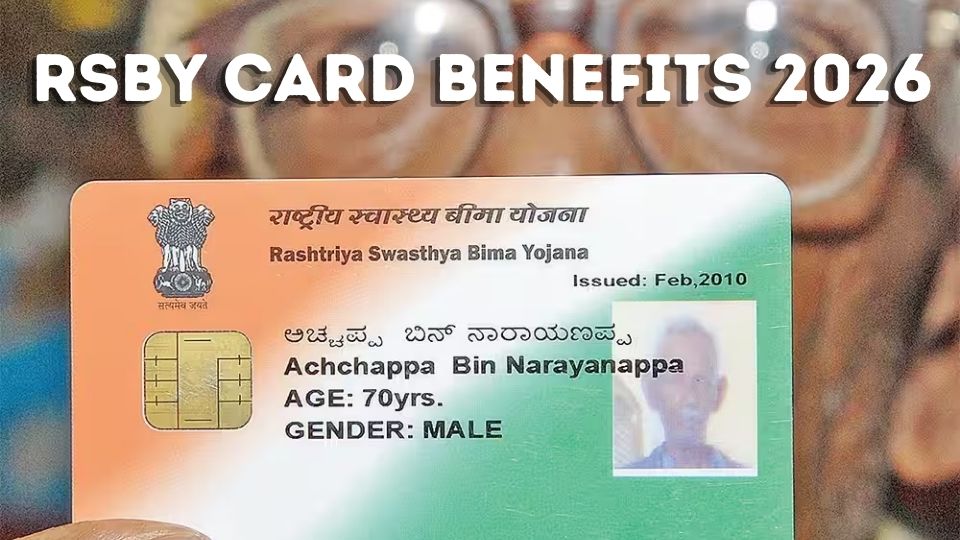
Important: RSBY is a historical scheme. Its original benefits and eligibility rules should not be confused with the current Ayushman Bharat/PM-JAY system. If you are checking whether you can currently use an RSBY card, verify with the relevant government health authority or current health insurance programme.
RSBY Card Benefits at a Glance
| Feature | RSBY Benefit |
|---|---|
| Scheme Name | Rashtriya Swasthya Bima Yojana |
| Launch Date | 1 October 2007 |
| Operational From | 1 April 2008 |
| Original Target Group | BPL families and eligible unorganised-sector workers |
| Health Cover | Up to ₹30,000 per family per year |
| Family Coverage | Family floater, generally up to 5 members |
| Treatment | Cashless hospitalisation at empanelled hospitals |
| Pre-existing Diseases | Covered from the beginning |
| Maternity | Included under the scheme |
| Transport Allowance | Available subject to scheme limits |
| Card Type | Smart card |
The original RSBY framework provided ₹30,000 annual hospitalisation cover per family on a family-floater basis.
What Are the Main RSBY Card Benefits?
1. Cashless Hospital Treatment
One of the major features of the RSBY card was cashless treatment at participating hospitals. The smart card was used to identify the beneficiary and process covered treatment.
This reduced the need for eligible families to arrange money immediately for covered hospitalisation expenses.
2. ₹30,000 Health Insurance Cover
The original scheme provided health insurance coverage of up to ₹30,000 per family per year.
It was structured as a family floater, meaning the available amount could be used by covered members of the family according to the scheme’s rules.
3. Coverage for Pre-existing Diseases
RSBY included pre-existing diseases from the beginning of coverage, which was an important feature of the scheme.
4. Maternity Benefits
The scheme included maternity-related hospitalisation benefits. Government information also stated that a newborn could receive coverage for the remaining period of the policy.
5. Transportation Allowance
RSBY also provided a transportation allowance for eligible hospital visits. Government scheme information specified transportation assistance within an overall annual limit of ₹1,000 under the original framework.
6. Day-Care Procedures
Certain surgical or medical procedures that could be performed as day-care procedures were included in the scheme’s coverage, subject to the applicable package and scheme conditions.
7. Pre- and Post-Hospitalisation Expenses
The original RSBY guidelines included certain pre- and post-hospitalisation expenses, including one day before hospitalisation and five days after hospitalisation, subject to the scheme’s conditions.
8. Access to Public and Private Hospitals
Beneficiaries could receive treatment through empanelled public and private hospitals. The smart-card system was designed to allow beneficiaries to use participating hospitals within the RSBY network.
Who Was Eligible for RSBY?
Originally, RSBY primarily targeted BPL families in the unorganised sector. Over time, the programme was also extended to certain categories of workers, including building and construction workers, street vendors, beedi workers, domestic workers and certain MGNREGA beneficiaries.
Eligibility and coverage could vary depending on the category and implementation by the respective state.
RSBY Card: Important Features
The smart card was an important part of the scheme because it enabled:
- Beneficiary identification
- Cashless transactions
- Access to participating hospitals
- Electronic processing of covered treatment
- Portability within the RSBY hospital network
- Biometric identification in the smart-card system
The government described the smart card as central to the cashless and interoperable nature of RSBY.
Was There Any Registration Fee?
Under the original RSBY structure, beneficiaries paid a ₹30 annual registration/renewal fee, while the government financed the major portion of the insurance premium.
Is RSBY Still Available?
This is an important point for anyone searching for “RSBY Card Benefits 2026.”
RSBY was an earlier health insurance programme. Therefore, information about the original ₹30,000 RSBY cover should not automatically be treated as a current 2026 benefit.
For current government-funded health coverage, beneficiaries should check the applicable Ayushman Bharat/PM-JAY or state health scheme and verify their eligibility through official government channels.
RSBY vs Current Health Schemes
| Point | RSBY |
|---|---|
| Nature | Earlier government health insurance scheme |
| Main beneficiaries | Originally BPL and eligible unorganised workers |
| Original annual cover | ₹30,000 |
| Card | Smart card |
| Treatment | Cashless at empanelled hospitals |
| Pre-existing diseases | Covered |
| Maternity | Included |
| Current applicability | Verify with government authorities |
Frequently Asked Questions
What is an RSBY card?
An RSBY card was a smart card issued to eligible beneficiaries under the Rashtriya Swasthya Bima Yojana. It was used to access covered cashless hospitalisation services at participating hospitals.
How much coverage was provided under RSBY?
The original RSBY scheme provided up to ₹30,000 per family per year on a family-floater basis.
Did RSBY cover pre-existing diseases?
Yes. Pre-existing diseases were included under the original RSBY framework.
Did RSBY cover maternity expenses?
Yes. Maternity benefits were included within the scheme’s covered hospitalisation services, subject to applicable conditions.
Can I use an old RSBY card today?
Because RSBY is an earlier scheme, do not assume that an old card provides active coverage today. Check your current eligibility and available government health coverage through the appropriate government health programme.
Conclusion
The Rashtriya Swasthya Bima Yojana (RSBY) was introduced to provide health insurance protection to economically vulnerable families and eligible workers in the unorganised sector. Its major features included cashless hospitalisation, ₹30,000 annual family coverage, pre-existing disease coverage, maternity benefits, transportation assistance and access to empanelled hospitals.
For current healthcare benefits in 2026, however, readers should verify the present-day government health scheme and eligibility rather than relying only on old RSBY card information.