

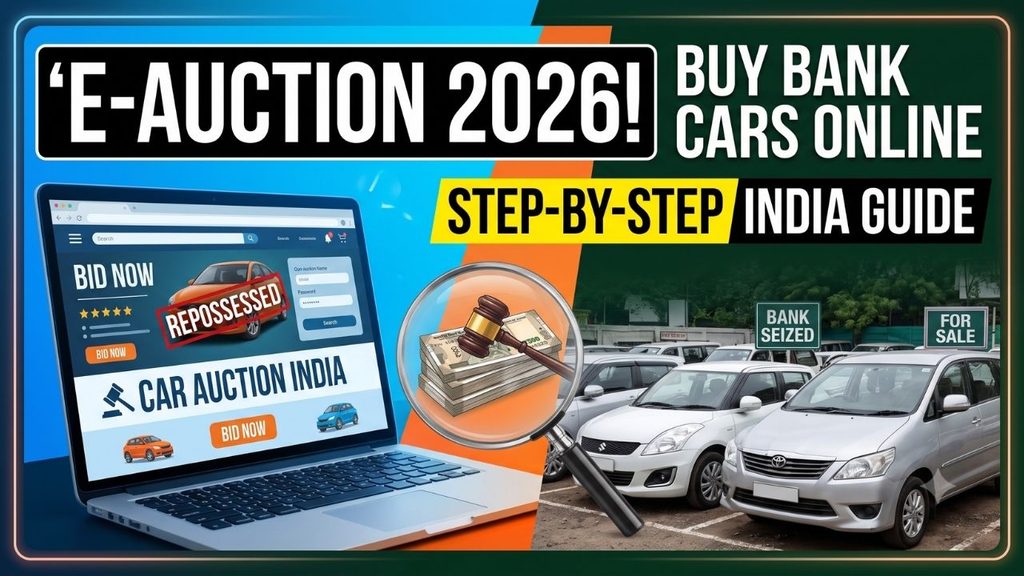
Buying a car through a bank e-auction can be an option for people looking for vehicles at potentially lower prices than the regular used-car market. Banks and financial institutions may auction vehicles that have been repossessed because borrowers failed to repay their loans.
These vehicles are generally sold through an online e-auction process, where eligible buyers can register, inspect the vehicle, submit an Earnest Money Deposit (EMD), and participate in competitive bidding.
However, buying an auction vehicle is different from purchasing a car from a dealer. The vehicle is often sold on an “as is where is” and “as is what is” basis, so buyers should carefully check the vehicle and auction terms before bidding.
What Is a Bank Car E-Auction?
A bank car e-auction is an online auction in which a bank or authorized financial institution sells a vehicle that it has taken possession of after a loan default or other recovery proceedings.
For example:
Car Loan → Borrower Defaults → Bank Repossesses Vehicle → Auction Notice → Online Bidding → Highest Eligible Bidder → Payment & Delivery
The exact process and legal conditions can differ depending on the bank, lender, auction platform and type of recovery proceeding.
Why Do Banks Auction Cars?
Banks generally finance vehicles through loans. If the borrower stops making the required payments and the account becomes subject to recovery action, the lender may take possession of the secured vehicle according to applicable law and the loan agreement.
The vehicle may subsequently be sold through an auction to recover outstanding dues.
Common reasons include:
- Car loan default
- Long-term non-payment of EMIs
- Recovery proceedings
- Repossession of financed vehicles
- Settlement or recovery of outstanding dues
How to Find Bank-Seized Cars for E-Auction?
People interested in buying auction vehicles should look for official auction notices from banks and authorized auction service providers.
You may find auction information through:
- Official bank websites
- Official auction portals linked from bank notices
- Newspaper auction advertisements
- Authorized e-auction service providers
- Asset-recovery or secured-asset auction notices
Always verify that the auction is genuine before paying any money.
Important
Do not trust random WhatsApp messages, Facebook posts, Telegram groups or unofficial websites claiming to sell bank-seized cars.
Before registering or paying an EMD, verify:
- Bank/lender name
- Auction notice
- Auction reference number
- Vehicle details
- Official auction platform
- EMD/payment instructions
- Terms and conditions
How to Buy a Bank-Auction Car Online?
The process generally follows these steps.
Step 1: Find an Auction Notice
Search for an active vehicle auction conducted by a bank or authorized auction agency.
Check:
- Vehicle model
- Registration number
- Location
- Reserve price
- Auction date
- EMD amount
- Inspection date
- Terms and conditions
Step 2: Register on the Auction Platform
You normally need to create an account on the specified auction platform.
Depending on the auction, you may be asked to provide details such as:
- Name
- Mobile number
- Email address
- Address
- PAN
- Identity/address documents
- Bank details
The exact requirements vary between auctions.
Step 3: Pay the EMD
An Earnest Money Deposit (EMD) may be required to participate.
The EMD is not necessarily the final purchase price. The auction notice should clearly explain the amount, payment method and refund/forfeiture conditions.
Never transfer the EMD to an unknown personal bank account.
Step 4: Inspect the Vehicle
This is one of the most important steps.
If physical inspection is permitted, inspect the car before bidding.
Check:
- Engine condition
- Gearbox
- Battery
- Tyres
- Body damage
- Interior condition
- Odometer
- Accident damage
- Signs of flooding
- RC details
- Chassis number
- Insurance status
- Keys available
- Vehicle documents
If you are not experienced with cars, consider taking a trusted mechanic with you.
Step 5: Check the Auction Terms
Read the complete auction notice and terms before placing a bid.
Pay particular attention to:
- Reserve price
- EMD
- Bid increment
- Auction date and time
- Payment deadline
- Inspection rules
- Taxes and charges
- Transfer requirements
- Conditions for refund of EMD
- Vehicle-related liabilities
- Whether the vehicle is sold on an “as is” basis
Step 6: Place Your Bid
After registration and approval, you can participate in the online auction.
If your bid becomes the highest valid bid and meets the auction conditions, you may be declared the successful bidder.
Remember that the highest bid does not automatically mean the vehicle is yours until the auction authority confirms the sale according to its terms.
Step 7: Make the Remaining Payment
If you win, you will normally need to pay the balance amount within the deadline mentioned in the auction notice.
Missing the payment deadline can result in penalties or forfeiture of the EMD, depending on the terms.
Step 8: Complete Vehicle Transfer
After completing payment and receiving the required sale documents, the buyer needs to complete the applicable ownership-transfer and registration formalities.
Depending on the vehicle and auction, this may involve:
- Registration Certificate (RC)
- Sale certificate or sale confirmation documents
- Insurance
- Applicable taxes/fees
- NOC or other required documents
- RTO transfer procedures
The exact documentation should be confirmed with the auctioning institution and the relevant RTO.
Documents to Check Before Buying
Before bidding, carefully verify the available vehicle documents.
| Document/Detail | Why It Matters |
|---|---|
| RC | Confirms registration details |
| Chassis Number | Helps verify vehicle identity |
| Engine Number | Helps match vehicle records |
| Sale/Auction Documents | Required for the transaction |
| Insurance Details | Important for insurance and transfer |
| NOC, if applicable | May be required in certain cases |
| Tax/dues information | Helps identify additional liabilities |
| Auction Terms | Explains buyer obligations |
Advantages of Buying Bank-Auction Cars
There can be several advantages.
1. Potentially Lower Purchase Price
Some auction vehicles may be available below comparable used-car market prices. However, this is not guaranteed.
2. Online Bidding
Many auctions allow buyers to participate remotely through an online platform.
3. Different Models Available
Depending on the auction, you may find hatchbacks, sedans, SUVs and commercial vehicles.
4. Transparent Bidding Process
An online auction can provide a competitive bidding environment where eligible participants can submit bids according to the published rules.
Risks of Buying Bank-Seized Cars
A low auction price does not necessarily mean a cheap car.
Vehicle Condition
Some repossessed vehicles may have been poorly maintained or may have remained unused for an extended period.
Repair Costs
A car purchased cheaply may require significant repairs.
Documentation Issues
Transfer or documentation requirements may require additional time and expense.
Outstanding Dues
Buyers should carefully understand what liabilities, taxes, charges or transfer expenses are included or excluded under the auction terms.
No Normal Dealer Warranty
Auction vehicles generally do not come with the type of warranty or after-sales support you may receive from a professional used-car dealer.
How to Calculate the Real Cost
Do not compare only the auction bid with the market price.
Your actual cost may include:
Final Bid + Taxes/Charges + Auction Fees + Repairs + Insurance + Transfer/RTO Expenses + Other Applicable Costs
Example
Suppose:
- Winning bid = ₹3,00,000
- Repairs = ₹50,000
- Insurance = ₹20,000
- Transfer/other expenses = ₹15,000
Your approximate total cost becomes:
₹3,85,000
Therefore, a vehicle that appears to be a ₹3 lakh deal may actually cost significantly more.
Important Tips Before Bidding
Follow these precautions before participating in a bank car auction:
- Check the official auction notice.
- Inspect the vehicle personally whenever possible.
- Take a mechanic with you.
- Verify the registration and vehicle identification details.
- Check the auction terms carefully.
- Calculate repair and transfer costs.
- Set a maximum bidding price.
- Do not get emotionally involved in competitive bidding.
- Never pay money to unofficial agents.
- Keep copies of all payment receipts and auction documents.
- Understand the EMD refund/forfeiture rules.
- Verify the payment account details from the official auction notice.
Is Bank E-Auction Car Worth Buying?
A bank-auction car can be worth considering, but it depends entirely on the vehicle’s condition, documentation, total cost and auction terms.
For example, if a car has a market value of ₹5 lakh and your total cost after bidding, repairs and other expenses is around ₹3.8 lakh, it could potentially be a good deal.
But if the car requires expensive engine, transmission or body repairs, the apparent discount may disappear.
Therefore, never bid only because the reserve price looks cheap.
Frequently Asked Questions
What is a bank-seized car?
A bank-seized car is generally a vehicle repossessed by a lender in connection with a loan default and subsequently offered for sale through an authorized recovery/auction process.
Can I buy bank-auction cars online?
Yes. Many vehicle auctions are conducted through online e-auction platforms. Buyers must follow the registration, EMD and bidding requirements specified in the auction notice.
Are bank-auction cars cheaper?
They can sometimes be available at attractive prices, but there is no guarantee. The final price depends on bidding competition and the vehicle’s condition.
Can I inspect a bank-auction car?
Many auction notices provide an inspection period or location. Buyers should check the specific auction notice before bidding.
Is EMD refundable?
It depends on the auction terms. Usually, the notice specifies when and how the EMD is refunded and the circumstances in which it can be forfeited.
Can I get a loan to buy an auction car?
This depends on the lender, vehicle documentation, buyer eligibility and the particular auction. Buyers should confirm financing availability before bidding.
What happens after I win the auction?
The successful bidder generally has to pay the remaining amount within the specified deadline and complete the required documentation and vehicle-transfer formalities.
Final Words
E-Auction of Cars by Banks can provide an alternative way to purchase used vehicles, but buyers should treat the process as a financial transaction requiring careful verification.
Before bidding, inspect the vehicle, verify documents, understand the auction conditions and calculate the total ownership cost, not just the winning bid.
Most importantly, use only official bank notices and authorized auction platforms and avoid paying money to unofficial agents or unknown individuals.
- Bank seized cars auction
- Bank auction cars
- Bank repossessed cars
- Car e-auction India
- Bank car auction online
- Seized vehicle auction
- Buy bank auction car
- Online car auction India